Cookie Jars, Honey Pots, Sugar Bowls, Butter Dishes, Covered Crocks, Canisters
Cookie Jars......$40-60
Baking Christmas cookies was always a challenge at our house. Especially the little butter press cookies: small, time-consuming, and wonderfully tasty. The problem was, with six kids and three adults, there never seemed to be any left to put away for Christmas.
One day I thought I'd found the answer. While everyone else was out getting a Christmas tree, I baked a double batch of cookies, cooled and froze them, and washed up and put away all the utensils. By the time they got back, there was no trace of my activities, and I had six dozen cookies put away.
My Dad was livid when he found out. Food is for sharing, not for hoarding, he told me. But how do I get any put away for Christmas if people keep eating them? I asked. You make more, he said.
So now I do.
Our easy to fill, easier-to-empty Cookie jars come in three sizes, 8-1/2, 10-1/2 and 12 inches high, respectively. I'd tell you what that is in cookie capacity, but I can't seem to keep them filled up long enough to count... They come in a wide variety of patterns, including mama tiger, the trouble bunnies, hummingbirds, running rooster and hen, and whatever else happened to inspire me before the last firing.
In any event, my uncle John Kuznacic's brother, George, kept bees. I never met him nor saw his hives, but whenever my folks went down for a visit, they'd bring back cases of honey in quart jars, a year's supply. That's where I learned that honey comes in different varieties, depending on the flowers pollinated. Clover honey is rich gold, by far the most common. Alfalfa honey, my favorite, is pale lemony yellow in color, lighter in flavor too. Dad and Grandma preferred buckwheat honey, so dark brown it was almost black, dark-tasting as well.
No matter what your favorite honey is, it will serve well from our Honey Jars. Each holds over a pint, comes with a hardwood honey stick, and has a bear cub painted on the front.
My sugar bowls are based on the Toddler bowl shape and size, but with a lid that includes a slot for your sugar spoon. Patterns include bear, bunnies, chickadees and chickens. Since I don't believe in ceramic spoons--too fragile!--I leave you to provide your favorite silver or stainless utensil.
Television doesn't make much sense when you're growing up in the country. (Does it make sense anywhere else? I doubt it.) I refer here specifically to its portrayal of the milkman, the smiling fellow in white who leaves glass bottles of dairy goodness on the doorstep.
Our milkman wore white, true, but he collected milk, rather than delivering it, with a giant truck that pumped out the contents of our bulk tank in two minutes flat. Glenn was a bit of a giant himself; he'd got his start in the business throwing around 25-gallon milk cans.
He did deliver butter and cheese, though. We'd leave a note on the bulk tank, and he'd bring what
we wanted from the co-op the next time he came by.
French butter
dishes are easy. I make dozens of them, and love that flat top, so perfect for
painting on.
The French Butter Dish (or Butter Bell, or French
Butter Crock) was used to keep butter fresh before refrigeration became common. Now days, it keeps
butter solid but spreadably soft without refrigeration. To use one, pack
butter into the lid, then put water into the base until about 1/3 full. When the lid is on, a
seal is created that keeps oxygen away from the butter; evaporation of the water keeps it cool.
It will stay soft and fresh. (Disclaimer: At kitchen temperatures above 90 ° F. even a French
Butter Dish will need to be refrigerated.)
I tried. I cut clay dies to extrude butter dish parts.
They curled closed in drying, warped in firing. I hand-built butter dishes.
They took forever to make, and I didn't like the results. Not very consistent,
not very pretty. But I kept on thinking about the problem.
I think I finally solved it. My new Stick Butter Dishes
incorporate a thrown-and-altered dish and lid, extruded rim and hand-built feet.
They're painted with grazing cows seen from various angles, and at $37, cost just a
little more than French Butter Dishes.
Small covered crocks came from customer requests. A lot of people liked the look of my covered
casseroles, but wanted something smaller. I've never been entirely sure what they're used for: butter
dish? Dip, salsa, chutney, jam? One of my customers swears by them for making homemade yogurt. And they're
also oven and microwave-safe, so you could bake or reheat individual servings in them. I guess it's
up to you...
And of course, because my people are nothing if not inventive (and, well, demanding), I immediately
got requests for a tall covered crock. Larger than the small ones, smaller than a cookie jar,
straight-sided as well. I usually have several different patterns in stock, bunnies, horses, rooster or hummingbird. Occasionally, I might paint a peacock.
Sugar Bowls......$24
French Butter Dishes......$30
Stick Butter Dishes......$37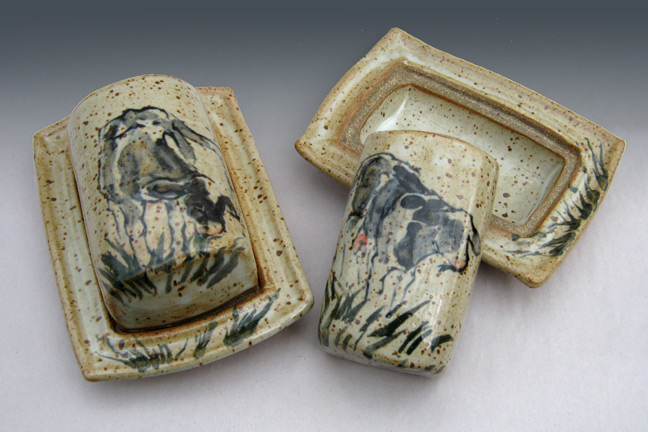 I used to make domed butter dishes, basically lidded plates,
each with a cow-mug style handle. They never sold well, probably because
they were big and round. Didn't
fit in the 'fridge. I finally stopped bringing them to shows, because everyone
wanted stick butter dishes.
I used to make domed butter dishes, basically lidded plates,
each with a cow-mug style handle. They never sold well, probably because
they were big and round. Didn't
fit in the 'fridge. I finally stopped bringing them to shows, because everyone
wanted stick butter dishes.
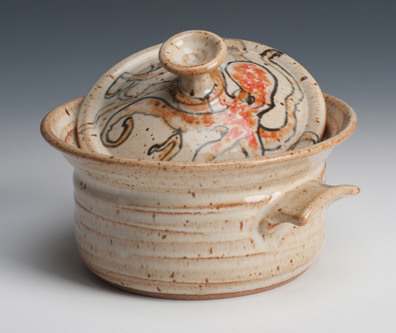
Small Covered Crocks......$33
Canisters (aka Tall Covered Crocks)......$38