Bobbin' Along
Ah, the signs of spring... Daffodils. Tulips. Robins on the lawn, angleworms on the sidewalk. Frost on the car windows.
Okay, so it's not been a typical spring. Flowering cherry trees alternating with snow and sleet. But rain or hail or even (gulp!) snow, one sign of spring remains constant:
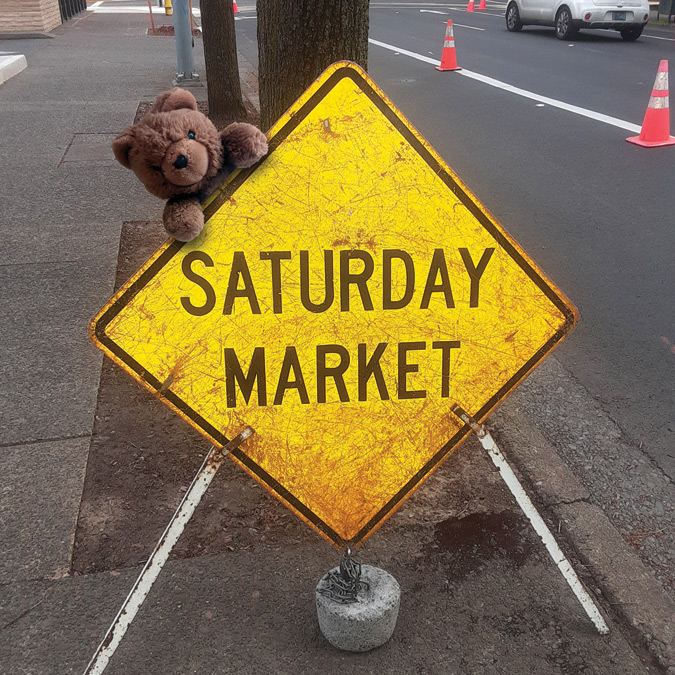
Saturday Market.
Regardless what the tulips are doing, Market booths are opening every year on the first Saturday of April. We'll be there at the Park blocks, bright and early Saturday to welcome spring back to our little corner of the Willamette Valley.
Whether it's ready or not.
Another sign of spring, though a more sheltered one, is the Oregon Potters' Association's annual Ceramic Showcase, held every year at the Oregon Convention Center in Portland. This year's show is April 25, 26 and 27. Showcase is open 10 am-9 pm Friday and Saturday, 10 am-5 pm Sunday, and we'll be in booth A-7. And check out the nice little inset photo on their postcard.
Every year the opening day of Showcase brings busloads of art students on field trips from around the Portland area to ogle the pots, watch the demos, and fill up the stairways, talking and eating bad sack lunches (or even worse, Convention Center food). They often have a class assignment to fulfill as well, usually finding a potter whose work interests them and subjecting him/her to a brief interview. I always enjoy the brief feeling of celebrity it gives me, talking with the kids. This year they seem to be starting early. I got two e-mails, from two different schools, asking questions about me and my work.
Since they both seem to have started at my web-site, I thought it'd be a public service to post their questions and my answers here, in case anybody is late in preparing their report. (Heck, one more e-mail and I may have to add this to my Occasionally Asked Questions page.)
Hi,
My name is ************* and I am in a high school pottery class and we are doing an assignment on local potters who inspirer you. I loved your work when I saw it online. So I was wondering if you could answer a few questions and get back to me at your earliest convenience. I would so much appreciate your time and effort!!
Questions!
1. What kind of education do you have to become a potter?
There's a lot of answers to that question. Some people start learning pottery in high school, and then go on to apprentice for a working potter and learn the trade from him/her. Others take classes at community colleges, go to workshops, or get a bachelor of arts or bachelor of fine arts degree in college. I went a step further, and have a master of fine arts (MFA) degree in ceramics from the University of Oregon. I also worked for a production potter for about three years, throwing his pots and getting paid by the piece. This is a step up from apprenticeship, where you usually don't get paid.
2. How did you get into doing pottery?
I took my first pottery class during my junior year in college, but didn't really get hooked on clay until my second class as a senior. After graduating, I worked for my college as a graphic artist, and kept making pots in my free time. I traded studio work--firing kilns, recycling clay--for workspace. I bought a used kickwheel and small electric kiln from a student in a class I was teaching, and took a couple of summer pottery workshops during my vacation time. I was an evening and weekend potter for about four years before I realized my day job was getting in the way of my pottery, so I started applying to graduate programs in ceramics.
3. How do you market your work?
Lots of ways, wholesale, retail, consignment, on-line:
Wholesale: this is great, if you can get it. A gift shop/gallery in Bellingham, WA buys my banks and incense burners in bulk for 50% of the retail price, and pays me net 30 (I get a check no more than 30 days from when they pick up the work). They run their store, pay the bills, and sell my work for me for the other 50% of the retail price.
Retail: This is harder work, but I get more of the money. I set up my booth at Eugene Saturday Market, or some out-of-town art fair and sell pots directly to the public. I have to pay a booth fee, and sometimes a percentage of sales, but it's less than wholesale, usually 10-20%. If I'm up in Washington state, I also have to collect sales tax and file a quarterly form with their department of revenue. I generally do 6-8 art fairs a year, in addition to Saturday Market and Holiday Market.
Consignment: This is when you leave your work with a gallery or gift shop to sell, and they pay you when it does. It's like wholesale, except you don't get the money up front. Since you're taking on faith their ability to sell your work, you usually get a bigger percentage, 60% of retail instead of 50%. I only have a couple of these, because I don't like having my work sit on someone else's shelves for free. One of the galleries, though, outsold all of my road shows last year, so with the right market, it's worth doing.
On-line: You've seen my web-site, www.offcenter.biz. It's not really set up for on-line selling like Amazon or E-Bay; it's more like a video catalog. I can update patterns, prices, tell where I'm going to be, and not have to pay a printer and lug paper catalogs around. I get a fair number of e-mail inquiries from my web-site, especially after I've done a show somewhere. I give away business cards to anyone who stops and looks, and they all have my web address. I also occasionally get inquiries from someone who Googled some strange phrase ("Pottery with ducks on it" was one) and wound up with me.
4. How does form and function apply to pottery forms and what types of knowledge, tools and skills are needed to create a successful piece?
You wouldn't think it from looking at all the painted surfaces on my pots, but I'm really fussy about function. I want my pitchers and teapots to pour, my bakers and casseroles to bake, my mugs to feel good in your hand and my bowls to not break in the sink.
So I think about form and function, and I experiment with different shapes, and I use a clay body that's tough and a glaze that's dense and easily cleaned and incidentally takes my overglaze painting well. Most of all, I use pottery in my everyday life. I cook in it, bake in it, eat out of it. I know what works and doesn't work because it's field-tested in my kitchen.
As for tools for making pots: all my work starts on the potter's wheel. I alter the shape (vases and square baking dishes) when wet, add handles and trim feet when leather-hard. I use fairly standard tools for forming, wood and metal and rubber ribs, cut-off wire, probe. I bought a couple of expensive tools for trimming: a Giffin Grip that re-centers and holds the pot I'm trimming (which I've had for over 20 years, so it's been a worthwhile investment), and a $50 trim tool that I bought at a ceramics conference in Portland. I thought I was being extravagant at the time, but it's the perfect shape for me and made from tungsten, so I never have to sharpen it and it's already lasted longer than three other cheaper trimmers.
For decorating, I'm very fussy: I make my own paintbrushes. I've got a big jar of brushes, two or three for every color overglaze I use, some purchased but at least one handmade for line drawings in each color.
I bisque fire in an electric kiln at my home studio, but I prefer the glaze effects I get from a gas reduction firing. I'm a member of a clay co-op called Club Mud, and do my glaze firings in a 40 cubic-foot car kiln there.
Thanks again for all your time,
Bet you didn't expect me to write this much, did you?
Okay, I'm not sure I've ever seen a wolf. At the Wolf Woods of the Minnesota Zoo, I've seen... woods. At the Cascadia Trail at Washington Park Zoo, Portland, I've seen... trail. And trees. At the Anchorage Zoo I might have seen a tuft of fur hanging off the brush. Or it might have drifted over the fence from the moose. I didn't see them either.
But wolves hold a fascination with us. There were always rumors around in winter, when I was a kid, about how wolves were coming back to Wisconsin. Someone had heard howling, someone had seen tracks out snowmobiling, someone else's cow dog was half "brush wolf." (Possibly coyote, but more likely the neighbor's German shepherd had jumped the fence.) Wolves hold a large place in our imagination, from children's stories to t-shirt art to wildlife movies.
So I keep getting requests for wolf pots. And I huff and puff and say how hard they are to draw right (one false line and it's a schnauzer). But I think I've finally got a wolf that looks like a wolf, and I'm painting them on pies, dessert plates, and my new tall mugs.
It's a howling success...